
Opening an app account can mean accepting an arbitration clause. But what happens when the account holder later brings a wrongful death claim arising from someone else’s ride? The Illinois Supreme Court’s September 24, 2026 decision in Geller answers that question by focusing on the contract’s wording, whose use of Uber caused the dispute, and the different legal capacities in which the surviving spouse acted.
For Illinois families and lawyers handling rideshare litigation, the decision shows why an arbitration dispute requires more than finding a clause in a set of app terms.
- Case
- Geller v. Uber Technologies, Inc.
- Citation
- 2026 IL 132066 · Docket No. 132066
- Court and decision date
- Illinois Supreme Court · September 24, 2026
- Opinion
- Justice Overstreet · Unanimous
- Result
- Appellate court reversed; circuit court affirmed; case remanded.
What happened in Geller v. Uber?
On April 19, 2022, Mark Geller requested a ride through Uber. During the trip, driver Ejaz Rathore lost control of the vehicle on an expressway. The crash fatally injured both men. Mark’s wife, Gloria Sheridan Geller, filed suit as independent administrator of his estate against Uber Technologies, Inc., its subsidiary Rasier, LLC, and Rathore. The complaint alleged negligence, Uber’s vicarious liability, survival claims, and wrongful death claims. These were allegations; the Supreme Court’s decision did not determine fault. Geller, ¶¶ 1, 6.
Both Mark and Sheridan had accepted Uber terms individually. The circuit court ordered the survival claims to arbitration under Mark’s agreement but refused to send the wrongful death claims to arbitration under Sheridan’s separate agreement. The estate then voluntarily dismissed the survival claims. Geller, ¶ 10.
The appellate court reversed, reasoning that a delegation clause in Sheridan’s agreement required an arbitrator to decide whether the wrongful death claims belonged in arbitration. The Illinois Supreme Court disagreed and restored the circuit court’s denial of Uber’s motion. Geller, ¶¶ 13–15, 76–79.
Wrongful death and survival claims protect different interests
The distinction between these two claims explains why the deceased passenger’s agreement did not end the analysis.
| Question | Wrongful death claim | Survival claim |
|---|---|---|
| What does it address? | The surviving spouse’s and next of kin’s losses caused by the death. | Injury and claims the deceased person had before death. |
| When does it arise? | A new cause of action accrues at death. | An existing claim continues after death. |
| Who brings it? | The personal representative, for the statutory beneficiaries’ benefit. | The deceased person’s representative, on behalf of the estate. |
| Whose interest is at stake? | The beneficiaries’ interest; recovery is not an asset of the deceased person’s estate. | The deceased person’s claim preserved for the estate. |
| What happened in Geller? | These counts may resume in circuit court. | The circuit court ordered arbitration; the estate voluntarily dismissed these counts, which remain dismissed. |
The court explained these principles through the Illinois Wrongful Death Act, 740 ILCS 180, the Survival Act, 755 ILCS 5/27-6, and its earlier decision in Carter v. SSC Odin Operating Co., 2012 IL 113204. A personal representative files a wrongful death action as a statutory trustee for the beneficiaries. The fact that the lawsuit is filed in the representative’s name does not make the recovery an estate asset that the deceased person could restrict through a lifetime arbitration agreement. Geller, ¶¶ 24–28.
Sheridan therefore had three relevant roles: individual Uber customer, surviving spouse and statutory beneficiary, and estate administrator. Her agreement as an app user had to be examined in light of the particular claim she was bringing. Geller, ¶ 25.
The court answered two separate arbitration questions
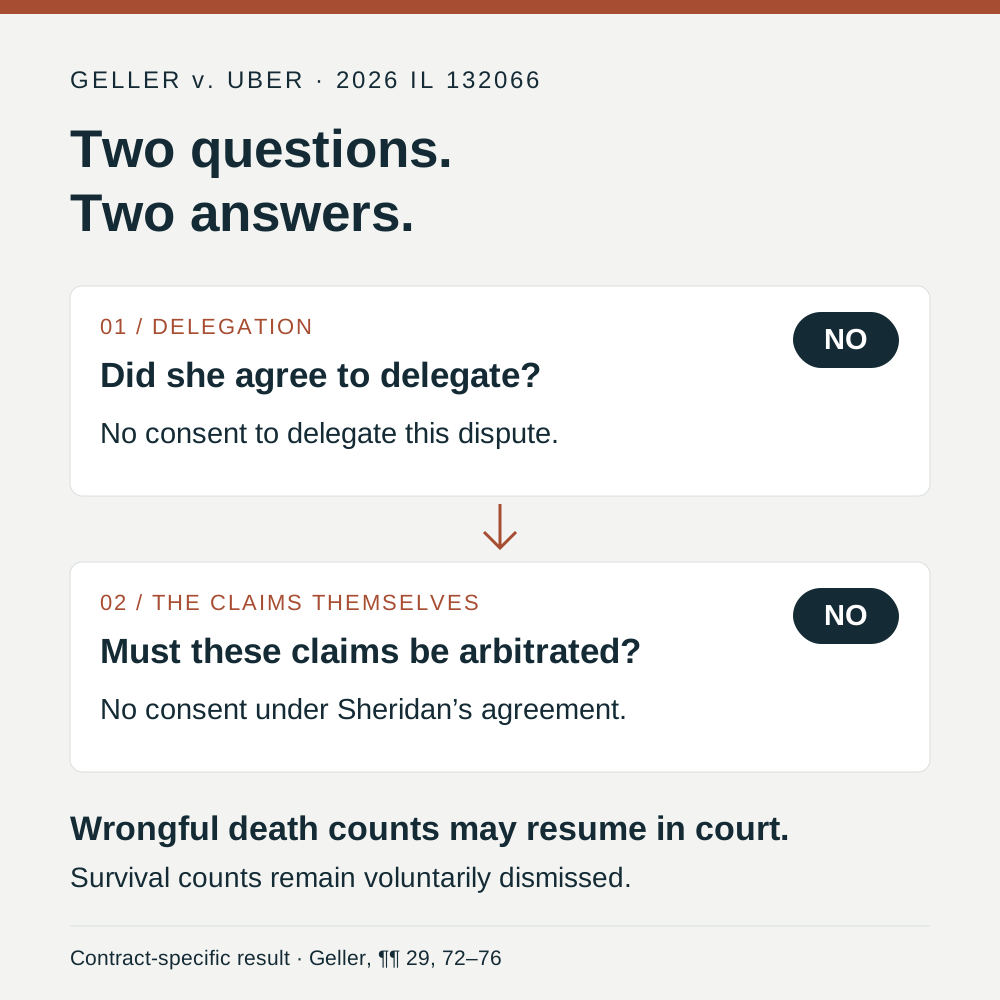
1. Did Sheridan agree to let an arbitrator decide whether these claims were arbitrable?
No. “Arbitrability” means whether a dispute must be resolved in arbitration. A delegation clause is an additional agreement that gives an arbitrator authority to decide that threshold question. Courts generally decide arbitrability unless the parties clearly and unmistakably agree to delegate it. Geller, ¶¶ 34–41.
The court found no clear and unmistakable agreement that Sheridan, as a wrongful death beneficiary or personal representative, would delegate arbitrability of claims arising solely from Mark’s separate use of Uber. Geller, ¶¶ 63, 67, 70.
2. Did Sheridan agree to arbitrate the wrongful death claims themselves?
No. After resolving delegation, the court also addressed the underlying dispute. Sheridan’s individual terms did not express consent to arbitrate these claims arising from Mark’s use, and she was not a signatory to Mark’s agreement. The court affirmed denial of arbitration of the wrongful death claims themselves. Geller, ¶¶ 72–74.
Why the words “your use” mattered
Sheridan’s terms repeatedly connected arbitration to her own access to or use of Uber’s services. Even the provision covering third-party claims tied those claims to her use. The delegation language sat within that contractual framework. Mark’s fatal ride arose from his separate use of Uber. Geller, ¶¶ 42–45.
The presence of a delegation clause and incorporation of American Arbitration Association rules did not establish consent to delegate this unrelated dispute. The court read the terms as a whole rather than treating the delegation language as unlimited. Geller, ¶¶ 43–48.
Uber argued that the court’s reasoning conflicted with Henry Schein, Inc. v. Archer & White Sales, Inc., which rejected a judicial “wholly groundless” exception to valid delegation agreements. The Illinois Supreme Court explained that it was addressing an earlier question: Did these parties agree to delegate arbitrability of this dispute in the first place? Without that agreement, there was no delegation to enforce. Geller, ¶¶ 51–63.
What Geller means for Illinois wrongful death cases
My reading of the decision: the useful starting point is to identify whose claim is being asserted, whose account and transaction generated it, and what the actual agreement covers. Treating every claim against a platform as an account-related dispute can skip the consent inquiry the court required.
For a family evaluating a fatal rideshare crash, that makes several records especially useful:
- The ride and account records: who requested the trip and whose use of the platform produced the dispute.
- The accepted terms: the version, acceptance history, and language connecting arbitration and delegation to particular claims.
- The plaintiff’s legal capacity: individual customer, statutory beneficiary, estate representative, or another role.
- The pleaded claims and their procedural status: wrongful death and survival counts require separate analysis.
These are practical implications of the opinion, not a guarantee that another family’s case will follow the same path. Different contract language or different participation in the underlying transaction could require a different analysis.
What the court left undecided
The Supreme Court did not decide Uber’s ultimate liability, award damages, or hold all rideshare arbitration agreements invalid. It also expressly declined to decide whether Sheridan’s agreement was procedurally or substantively unconscionable. Its decision rested on consent and the language of the agreement. Geller, ¶¶ 18, 74–76.
On remand, the wrongful death counts may resume in the circuit court of Cook County. The survival counts remain dismissed following the estate’s voluntary dismissal. Geller, ¶ 76.
Frequently asked questions about Geller v. Uber
What did the Illinois Supreme Court decide in Geller v. Uber?
The court held that Gloria Sheridan Geller’s separate Uber agreement did not require arbitration of wrongful death claims arising solely from her husband Mark Geller’s ride. It rejected both delegation of the arbitrability question and arbitration of the underlying wrongful death claims under that agreement.
Can an Uber arbitration agreement prevent a wrongful death lawsuit in Illinois?
Geller does not create a universal exemption from arbitration. It holds that the wife’s agreement, tied to her own use of Uber, did not cover wrongful death claims arising solely from her husband’s separate ride. The contract language, account use, and parties’ legal capacities matter.
Who decides whether a claim must go to arbitration?
Courts generally decide arbitrability unless the parties clearly and unmistakably agree to delegate that question to an arbitrator. In Geller, the court found no such agreement for these wrongful death claims, even though the wife’s terms included a delegation clause.
What is the difference between wrongful death and survival claims in Illinois?
A survival claim preserves a claim the deceased person had before death. A wrongful death claim accrues at death and is brought by the personal representative for the benefit of the surviving spouse and next of kin. The claims protect different interests and can have different arbitration outcomes.
Did Geller hold that Uber’s arbitration agreement was unconscionable?
No. The Illinois Supreme Court resolved the case on consent and the agreement’s language. It expressly declined to decide the procedural and substantive unconscionability arguments.
What happens to the Geller lawsuit after the decision?
The wrongful death counts may resume in the circuit court of Cook County. The survival counts remain dismissed because the estate voluntarily dismissed them after the circuit court ordered them to arbitration. The Supreme Court did not decide negligence, damages, or Uber’s ultimate liability.
Primary sources and case references
- Geller v. Uber Technologies, Inc., 2026 IL 132066 — official Illinois Supreme Court opinion (PDF), filed September 24, 2026. Paragraph citations throughout this article refer to this opinion.
- Carter v. SSC Odin Operating Co., 2012 IL 113204 — official Illinois Supreme Court opinion (PDF), particularly ¶¶ 32–46 and 57, as discussed in Geller.
- Illinois Wrongful Death Act, 740 ILCS 180/1–2, and Survival Act, 755 ILCS 5/27-6, as quoted and discussed in Geller, ¶¶ 22–28.
Analysis prepared October 1, 2026, from the supplied opinion and the official court copy. General legal information; not advice about a particular case. Reading this article or contacting the office does not create an attorney-client relationship. See the website disclaimer.