
For an Illinois family investigating medical care during the pandemic, an immunity defense can sound like the end of the case. Jarrett shows why the details still matter: the date of treatment, the particular legal protection invoked, and the evidence connecting the provider’s work to a State request.
The central distinction is straightforward. Proof that a disaster existed is different from proof that someone rendered assistance at the State’s request. Section 21(c) required both. A continuing emergency declaration did not fill the evidentiary gap in this case.
- Case
- Jarrett v. McGhee, 2026 IL App (2d) 250474
- Court
- Illinois Appellate Court, Second District
- Filed
- October 5, 2026
- Claim
- Medical negligence action brought by John Wayne Jarrett, administrator of Rose Jarrett’s estate, against nurse practitioner Julie McGhee
- Issue
- Whether the defendant established immunity under 20 ILCS 3305/21(c) for July 2021 care
- Result
- Reversed and remanded to the DeKalb County circuit court
- Status
- Published opinion; listed by Illinois Courts as a slip opinion on October 5, 2026
What happened in Jarrett v. McGhee?
According to the amended complaint, Rose Jarrett developed an intestinal leak after surgery at Kishwaukee Community Hospital in DeKalb on June 21, 2021. Following a discharge and readmission, she entered Generations at Neighbors, a rehabilitation facility in Byron, on July 8. McGhee worked there as a nurse practitioner. Opinion, ¶ 3.
The complaint alleged that Jarrett’s blood work showed high white blood cell counts while she was at the facility. She was transferred to another hospital on July 15, where surgery revealed a substantial abdominal abscess and fecal peritonitis. The estate alleged that the resulting sepsis, delayed chemotherapy, and other complications contributed to her death on May 10, 2022, and that McGhee’s negligence was a proximate cause. These were allegations, not findings that malpractice occurred. Opinion, ¶ 3.
McGhee sought dismissal under section 2-619 and summary judgment under section 2-1005, arguing that the Illinois Emergency Management Agency Act protected her from liability. The trial court accepted the immunity defense and dismissed the claims against her with prejudice. The appellate court reviewed that ruling independently, under the de novo standard. Opinion, ¶¶ 11–15.
What must a healthcare provider establish for section 21(c) immunity?
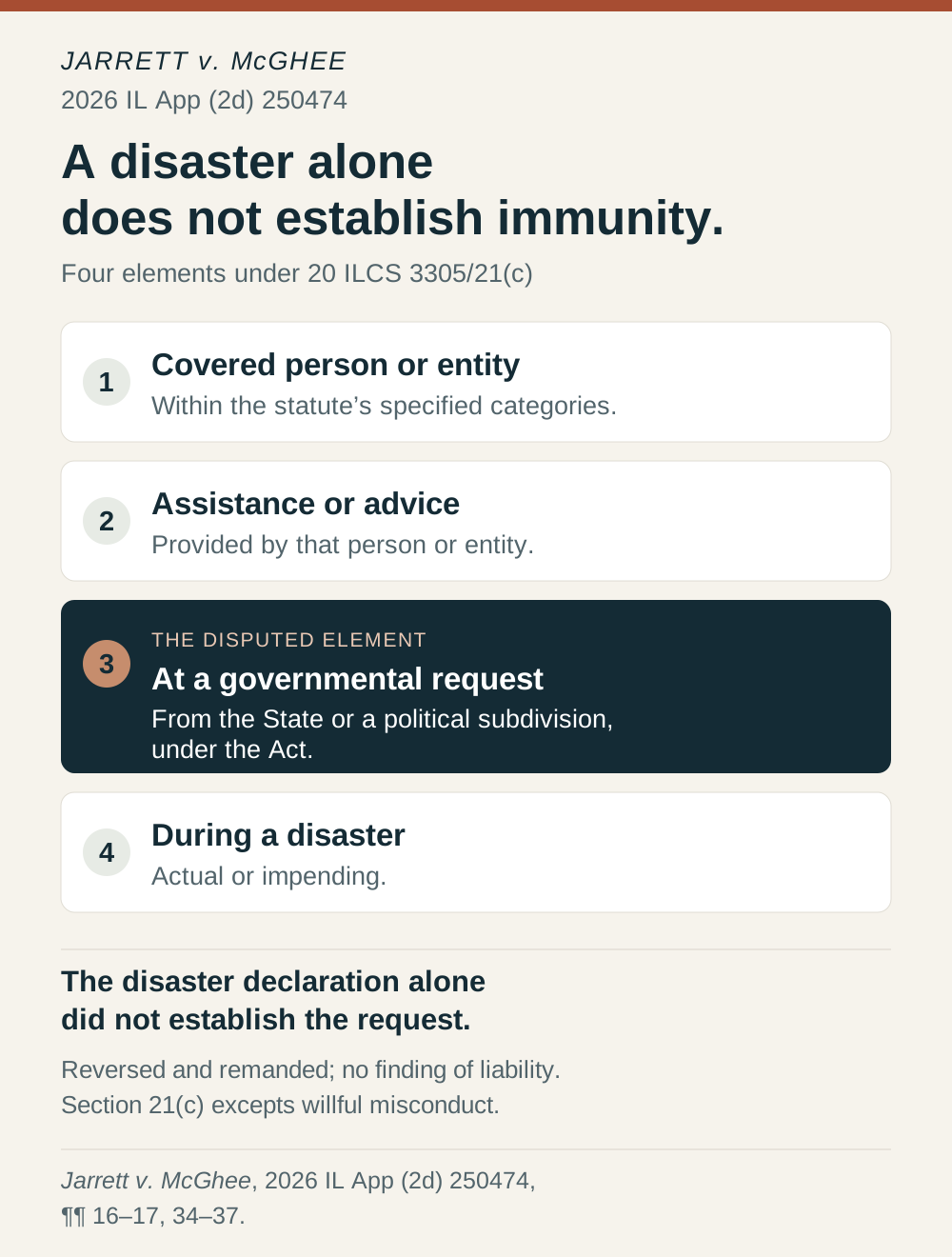
The statute at issue was section 21(c) of the Illinois Emergency Management Agency Act, 20 ILCS 3305/21(c) (West 2020). It protects specified private actors who render assistance or advice at the request of the State, or a political subdivision under the Act, during an actual or impending disaster, except in the event of willful misconduct. The court identified four elements. Opinion, ¶¶ 16–17.
- A covered person or entity: the defendant must fall within the protected statutory categories.
- Assistance or advice: the defendant must have rendered assistance or advice.
- A qualifying request: the assistance must have been rendered at the request of the State, or a political subdivision under the Act.
- A disaster: the assistance must have been rendered during an actual or impending disaster.
In Jarrett, the defendant’s covered status and the existence of a disaster were undisputed, and the provision of assistance was not seriously disputed. The decisive question was the third element: what supported the claimed request from the State?
Why did the executive-order timeline matter?
The relevant immunity orders were no longer in effect when the alleged negligence occurred. The court traced the orders individually instead of treating the entire pandemic as one continuous immunity period. Opinion, ¶¶ 5–10, 24.
April 1, 2020
Executive Order 2020-19
Directed specified healthcare actors to assist the State’s COVID-19 response and invoked statutory immunity, subject to its terms.
April 30, 2020
Executive Order 2020-33
Reissued and amended Order 2020-19, extending it through May 29, 2020.
May 13, 2020
Executive Order 2020-37
Changed the immunity provisions, with distinctions based on setting, elective surgery, and whether injury or death related to COVID-19.
May 29, 2020
Executive Order 2020-39
Recognized that Order 2020-37 superseded Order 2020-19 and extended Order 2020-37 through June 27, 2020.
June 25, 2021
Executive Order 2021-14
The order in effect during the July 2021 care did not renew these immunity orders or include a healthcare-worker immunity provision.
The later disaster proclamations did not automatically keep the earlier executive orders alive. The court relied on their specific extension and termination language. It also rejected the argument that the original order’s general reference to the duration of the disaster proclamations overrode those later, specific terms. Opinion, ¶¶ 35–37.
This is why the treatment date matters. The existence of broad protections at an earlier stage of the pandemic did not establish that those same protections covered this defendant’s conduct more than a year later.
Why weren’t pandemic precautions enough to prove a State request?
McGhee described attending pandemic-response meetings, stocking protective equipment, reporting COVID cases, and implementing Illinois Department of Public Health guidance. Her testimony also referred to distancing, isolation, monitoring symptoms, and general requests that healthcare employees continue working. Opinion, ¶¶ 28–30.
The problem was specificity. She did not identify the relevant communications with enough detail, explain the guidelines beyond general terms, or establish how they constituted a qualifying request. She also did not support the policy-guidelines argument with legal authority. The court held that conclusory assertions did not establish the defense. Opinion, ¶¶ 31–34.
Who had the burden of proving immunity?
The defendant had the initial burden. Immunity is an affirmative defense: a reason the defendant contends the lawsuit cannot proceed even if the complaint otherwise states a claim. Before the plaintiff had to counter the asserted immunity evidence, McGhee needed to produce sufficient support for the defense. Because she did not do so, the burden never shifted to the estate. Opinion, ¶¶ 32–34.
The opinion also applies Illinois Supreme Court Rule 191(a), which requires supporting affidavits to provide particular facts based on personal knowledge, rather than conclusions. General deposition statements did not cure that deficiency. The court separately declined to apply forfeiture against the estate for allegedly failing to address the request issue adequately below. That ruling depended on the circumstances; it is no reason to leave an immunity argument unanswered in the trial court. Opinion, ¶¶ 25–26, 33.
How does Jarrett fit with the Illinois Supreme Court’s James decision?
James v. Geneva Nursing & Rehabilitation Center, LLC, 2024 IL 130042, addressed Executive Order 2020-19 and ordinary negligence claims arising during the early pandemic. As Jarrett explains, James treated that order as the trigger for immunity derived from section 21(c), and examined the order’s language to determine the protection’s scope. Opinion, ¶¶ 20–23.
Jarrett applies that reasoning to a different time and record. Section 21(c) was not self-executing: a qualifying request was necessary. The earlier executive orders could not supply that trigger for July 2021, and McGhee did not establish another one.
The distinction is not simply whether the patient was being treated for COVID-19. The court noted James’s conclusion that the earlier immunity was not limited to negligence involving COVID treatment. The failure here concerned the legal trigger and the evidence supporting it. Opinion, ¶¶ 17, 23–24, 37.
What did the court leave unresolved?
- Whether another type of State request could establish immunity. The court did not hold that an executive order is the only possible trigger. The record lacked a specific, supported alternative for the court to evaluate.
- Whether policy guidance could ever qualify. The defendant did not adequately support that argument with facts and authority. The opinion does not categorically reject every possible guideline or agency communication.
- Whether malpractice caused Rose Jarrett’s death. Reversal of an immunity ruling is not a determination of breach, causation, or damages.
It would therefore overstate Jarrett to say that all pandemic-related immunity disappeared forever on June 27, 2020, or that every Illinois malpractice case involving later treatment must succeed. The holding concerns this immunity defense on this record. Opinion, ¶¶ 34–40; see also ¶ 23.
What does Jarrett mean for Illinois medical malpractice claims?
For patients and families, the practical lesson is to have the actual defense evaluated before assuming that pandemic-era care is immune from review. Medical records establish the treatment timeline; the relevant orders and other communications establish what legal protections might apply. The two need to be examined together.
For lawyers evaluating a section 21(c) defense, this decision suggests four concrete questions:
- When did the challenged care occur? Match the alleged acts or omissions to the orders then in effect.
- What precise request is being asserted? Identify the issuing government body, the communication, its date, the recipient, and the assistance requested.
- What admissible evidence supports that connection? Assess the actual documents and specific testimony, including Rule 191(a)’s requirements.
- What scope of protection follows? Read the operative language and the statutory exception for willful misconduct, rather than assuming every claim is covered.
These are practical implications of the opinion, not an additional test announced by the court. Jarrett neither extends filing deadlines nor decides whether another patient has a viable claim. For related background, see the site’s explanation of negligence and its updated legal context, or explore Jonathan Nessler’s Illinois injury and wrongful death practice.
Frequently asked questions
What did the court decide in Jarrett v. McGhee?
The Illinois Appellate Court reversed dismissal and summary judgment because nurse practitioner Julie McGhee did not establish section 21(c) immunity for July 2021 care. The relevant executive orders had expired, and she did not substantiate another qualifying State request. The case was remanded for further proceedings.
Does an Illinois COVID disaster declaration automatically create medical malpractice immunity?
No. In Jarrett, the disaster declaration established the disaster element but did not establish the separate requirement that assistance be rendered at a qualifying governmental request. The defendant had to support each necessary element of the asserted immunity defense.
Did all Illinois COVID healthcare immunity end on June 27, 2020?
Jarrett does not establish that broad proposition. The relevant executive orders had expired before the July 2021 care, but the court left unresolved whether another properly supported request could trigger section 21(c) immunity. McGhee did not establish an alternative trigger on this record.
Can following IDPH guidelines establish a request from the State?
The court did not decide that guidelines can never qualify. McGhee’s general testimony did not identify a sufficiently specific communication or explain, with supporting legal authority, why the guidelines constituted the required request. That record did not establish the defense.
Did Jarrett v. McGhee find the nurse practitioner liable for malpractice?
No. The court reversed an immunity ruling and returned the case for further proceedings. It did not decide whether McGhee was negligent, whether her conduct caused Rose Jarrett’s death, or whether the estate was entitled to damages.
Is Jarrett v. McGhee a published opinion?
Yes. Illinois Courts listed Jarrett v. McGhee, 2026 IL App (2d) 250474, as a Second District opinion with Slip status on October 5, 2026. It is not a Rule 23 nonprecedential order. The slip opinion remains subject to possible modification.
Primary sources and scope
- Jarrett v. McGhee, 2026 IL App (2d) 250474, filed October 5, 2026. Allegations: ¶ 3; orders and procedure: ¶¶ 4–15; statutory elements and James: ¶¶ 16–24; evidence and burden: ¶¶ 25–37; disposition: ¶¶ 39–40. Section 21(c) (West 2020) is reproduced in ¶¶ 4 and 16.
- Illinois Executive Order 2020-39, including the extension of Order 2020-37 through June 27, 2020.
- Illinois Executive Order 2021-14, the order addressed in Jarrett as operative during the July 2021 care.
- Illinois Courts opinion index and explanation of slip-opinion status. The court listed Jarrett as an Opinion, with Slip status, when checked October 5, 2026.
This article analyzes the October 5, 2026 opinion. A slip opinion may be modified; check the court’s current listing before relying on it. General legal information, not legal advice about a particular claim.