
A workplace injury claim can become a dispute about the record: what the employee lifted, when the pain began, what the first medical notes say, and which doctor offers the more persuasive explanation. This case shows why those details matter—and why an appeal is not a fresh opportunity to choose between competing witnesses.
- Case
- University of Illinois v. Illinois Workers’ Compensation Commission, 2026 IL App (5th) 260057WC-U
- Court
- Illinois Appellate Court, Fifth District, Workers’ Compensation Commission Division
- Filed
- October 2, 2026
- Worker
- Dawanna Thomas, a University of Illinois cook and caterer
- Result
- Affirmed: temporary total disability, past medical expenses, and permanent partial disability based on 10% loss of the person as a whole
- Status
- Rule 23(b) order; nonprecedential, with persuasive citation permitted under Rule 23(e)(1)
What happened at the University of Illinois catering event?
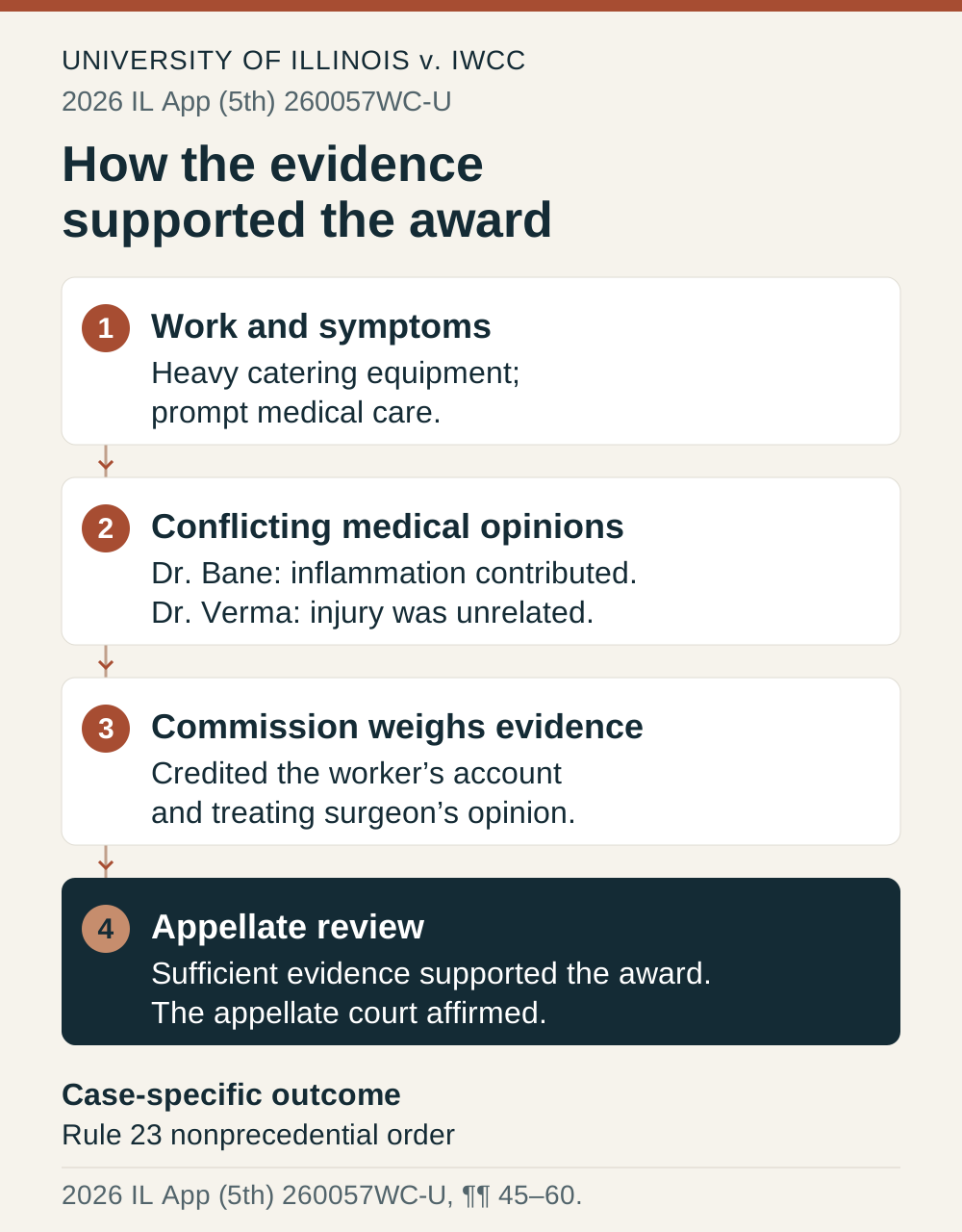
Thomas testified that she developed shooting pain from her right shoulder toward her elbow while exchanging chafing dishes at a catering event on August 23, 2019. The equipment had to be moved between tables, a wheeled cart, and a storage room as guests arrived. The evidence included a physical-demand analysis listing a chafer’s weight at 34.6 pounds. Order, ¶¶ 4–6, 27–34.
She sought emergency care that evening and returned for further evaluation in the following days. Her initial diagnoses included shoulder strain and bursitis. After continuing symptoms, injections, therapy, and imaging, orthopedic surgeon Dr. Robert Bane diagnosed adhesive capsulitis and performed a procedure in June 2020. During the procedure, he observed labral fraying but no significant tear. Order, ¶¶ 7–22, 35.
The arbitrator awarded benefits in September 2024. The Illinois Workers’ Compensation Commission (IWCC) unanimously affirmed and adopted that decision in May 2025. The Champaign County circuit court confirmed the award in January 2026, and the University appealed. Order, ¶¶ 41–43.
Why didn’t the inconsistent injury descriptions defeat the claim?
The court considered the medical records as a whole. The University pointed to notes suggesting that symptoms began before the event, denials of a traumatic or sudden injury, and differing references to pots, pans, a food tray, chafers, or a buffet cart. Those discrepancies were part of the evidence, not facts the court overlooked. Order, ¶¶ 44, 48–50.
Other records tied her symptoms to heavy lifting at work on the relevant Friday. Reports completed three days after the event described right-shoulder symptoms and pushing, pulling, and lifting equipment. The court concluded that the central account remained consistent: she developed shoulder pain while moving heavy serving equipment at work. Order, ¶¶ 47–50.
The supervisor’s testimony was mixed. He disputed receiving a report of a right-shoulder injury and recalled a complaint about back pain. But he confirmed that chafers needed to be exchanged and that Thomas could have performed that task. The appellate court found support for the Commission’s decision in the combined record; it did not describe every witness as agreeing on every detail. Order, ¶¶ 31–34, 46–50.
The University also challenged her credibility based on earlier workers’ compensation proceedings. The court deferred to the credibility determination made in this case. That is a case-specific conclusion, not permission to disregard inaccurate histories or unfavorable evidence. Order, ¶ 51.
How did the court address the conflicting medical opinions?
The doctors disagreed about causation, meaning whether the work incident contributed to Thomas’s shoulder condition. Their disagreement mattered because treatment can be reasonable and necessary even when the parties dispute who is legally responsible for paying for it.
| Physician | Opinion about work causation | Basis considered by the Commission |
|---|---|---|
| Dr. Robert Bane Treating surgeon | The described event caused inflammation that contributed to adhesive capsulitis, assuming the worker’s account was accurate. | He examined Thomas and performed her shoulder procedure. |
| Dr. Nikhil Verma University’s reviewing physician | The adhesive capsulitis was unrelated to work and occurred without an identifiable work cause. | He reviewed the records and other materials but did not examine Thomas. |
Both physicians regarded her treatment as reasonable; they disagreed on its relationship to her job. Dr. Bane acknowledged that adhesive capsulitis can develop without a precipitating event. He nevertheless connected this worker’s account to an inflammatory process. The Commission found his explanation more persuasive. Order, ¶¶ 35–40, 56–57.
The court did not establish an automatic preference for treating doctors. It held that resolving this conflict, weighing the testimony, and drawing reasonable inferences belonged to the Commission. Nor did it adopt a universal medical conclusion that lifting causes frozen shoulder. Its ruling addressed the evidence supporting this award. Order, ¶¶ 56–59.
What role did the “chain of events” play?
The court also considered the sequence of events. Before the incident, Thomas testified that she worked without restrictions and had no prior right-shoulder pain or treatment. The record contained no medical records showing treatment for right-shoulder pain before August 23, 2019. Her testimony, the subsequent records, and Dr. Bane’s opinion together supported the causal connection. The court did not rely on timing alone. Order, ¶¶ 58–59.
Why was the standard of review so important?
The appellate court was reviewing factual findings, not holding a new trial. The worker had to prove the elements of her claim by a preponderance of the evidence. On appeal, the accident and causation findings would stand unless they were against the manifest weight of the evidence—meaning an opposite conclusion was clearly apparent. The question was whether sufficient evidence supported the Commission, not whether the appellate judges might have decided differently. Order, ¶¶ 45, 55.
That distinction explains the result. The University identified competing evidence, but the Commission had a supported basis for crediting Thomas and Dr. Bane. Showing that another interpretation was possible did not establish that the award had to be reversed.
Which workers’ compensation benefits were upheld?
The affirmed award included the following benefits. Order, ¶ 41.
- Temporary total disability (TTD): August 24 through September 24, 2019, and June 24 through August 4, 2020.
- Medical benefits: past medical expenses.
- Permanent partial disability (PPD): an award based on 10% loss of the person as a whole.
The permanent-disability award was expressed as a percentage of the person as a whole, not 10% of the shoulder. The appellate order does not state a total dollar recovery. It also does not independently analyze benefit amounts: the University’s challenges to these benefits depended entirely on its accident and causation arguments. Once those arguments failed, the benefit challenges failed with them. Order, ¶ 60.
What should Illinois workers take from this decision?
For a worker dealing with disputed shoulder symptoms, the practical lesson is to preserve an accurate account of the work and the medical history. This decision illustrates the importance of:
- The actual task: what was lifted or moved, its approximate weight, the movement involved, and when symptoms appeared.
- Contemporaneous records: incident reports, early medical histories, work restrictions, and records of the employer’s response.
- A complete health history: prior symptoms and treatment, as well as periods of unrestricted work. Discuss apparent record errors with the provider instead of ignoring them.
- Medical reasoning: how the physician connects the specific work activity to the diagnosed condition, including any competing explanations.
For anyone evaluating an appeal, the lesson is equally practical: identify an error under the applicable standard of review. Repeating the losing side’s preferred interpretation of disputed evidence may not be enough.
Is University of Illinois v. IWCC binding precedent?
No, subject to Rule 23’s limited exceptions. The order was filed under Illinois Supreme Court Rule 23(b). Rule 23(e)(1) allows nonprecedential orders entered under subsection (b) on or after January 1, 2021, to be cited for persuasive purposes. It also preserves limited uses involving double jeopardy, res judicata, collateral estoppel, or law of the case. Illinois Supreme Court Rule 23(e)(1).
This distinction limits how the decision should be used. It illustrates how a court evaluated one record under established workers’ compensation principles. It does not announce a new entitlement for all workers with adhesive capsulitis. This article addresses the order filed October 2, 2026; readers citing it should check the court’s listing for any later modification or publication.
Frequently asked questions
Can frozen shoulder be covered by Illinois workers’ compensation?
It can be when the evidence establishes a causal relationship to work. In this case, the Commission credited a surgeon’s opinion that the described work event caused inflammation contributing to adhesive capsulitis. The appellate court upheld that finding; it did not hold that every frozen shoulder is work-related.
Do inconsistent medical histories automatically defeat a work-injury claim?
No. In this case, the court considered the records as a whole and found support for the Commission’s accident finding despite differences in the histories. Inconsistencies still matter, and their significance depends on the record and the Commission’s credibility findings.
Does a treating doctor’s opinion always outweigh the employer’s medical expert?
No. The Commission resolves conflicts in medical evidence. Here it found the treating surgeon’s opinion more persuasive, including because he examined and operated on the worker, while the University’s expert did not examine her. The order does not create an automatic preference.
What benefits did the court uphold for Dawanna Thomas?
The court upheld temporary total disability for August 24 through September 24, 2019, and June 24 through August 4, 2020; past medical expenses; and permanent partial disability based on 10% loss of the person as a whole. The appellate order does not state a total dollar recovery.
What does “against the manifest weight of the evidence” mean?
For the factual findings reviewed here, an opposite conclusion must be clearly apparent. The appellate court asked whether sufficient evidence supported the Commission’s decision, rather than deciding which witnesses it would have believed in a new trial.
Can lawyers cite this University of Illinois v. IWCC order?
Yes, for persuasive purposes under Illinois Supreme Court Rule 23(e)(1), because it is a Rule 23(b) order entered after January 1, 2021. It is nonprecedential, subject to the rule’s limited exceptions, and should not be presented as binding authority for every shoulder-injury claim.
Primary sources and scope
- University of Illinois v. Illinois Workers’ Compensation Commission, 2026 IL App (5th) 260057WC-U, filed October 2, 2026. Facts and proceedings: ¶¶ 4–43; accident and credibility: ¶¶ 44–53; causation: ¶¶ 54–59; benefits and disposition: ¶¶ 60–62.
- Illinois Supreme Court Rule 23, including subsection (e)(1) on nonprecedential orders and persuasive citation.
- Illinois Courts decision index, for the court’s current listing and any later status changes.
This article analyzes the appellate order and the evidence it describes. It provides general legal information, not medical advice or advice about a particular claim. Past outcomes do not guarantee a result in another case.