
A police officer may be able to write reports, sell a home, or sit at a desk and still be unable to chase a suspect or help another officer in a struggle. That difference is central to Mahan. The question was whether the officer had recovered enough to perform the required police work—not simply whether he could do some useful work.
The case also addresses something medical testing cannot fix: a decision-maker who has already made up their mind. A pension review must evaluate the evidence fairly, even after years of disagreement and earlier reversals.
- Case
- Mahan v. Marion Police Pension Board, 2026 IL App (5th) 260066
- Court
- Illinois Appellate Court, Fifth District; appeal from Williamson County
- Decision dates
- Order filed September 2, 2026; motion to publish granted October 6, 2026
- Benefit at issue
- Joshua Mahan’s line-of-duty police disability pension
- Result
- Termination reversed on evidentiary and due-process grounds
- Opinion status
- Published opinion; listed as Slip by Illinois Courts on October 6, 2026
What happened in Mahan v. Marion Police Pension Board?
Joshua Mahan suffered an injury while working for the Marion Police Department on May 20, 2011. The Board awarded a line-of-duty disability pension on July 26, 2012. Later reviews produced a lengthy dispute over whether he remained disabled. A 2018 termination was reversed by the circuit court; a 2021 termination ultimately was reversed in Mahan v. Marion Police Pension Board, 2023 IL App (5th) 210426. Opinion, ¶ 3.
The latest review hearing took place on November 21, 2024. Mahan testified that his upper-back condition had not improved since his earlier testimony. He described unpredictable spasms and difficulty with the physical confrontations that can arise during patrol. He was working as a modular-home salesperson, largely at a desk, but testified that he could not safely chase, tackle, or lift a resisting person or physically assist a fellow officer in need. Opinion, ¶¶ 9–16.
November 21, 2024
The Board votes to terminate benefits
Three members voted for termination and two opposed it after the review hearing.
April 9, 2025
A written decision follows
The Board relied on an independent medical examiner and rejected the functional capacity evaluation as unreliable.
December 31, 2025
The circuit court affirms
The Williamson County circuit court upheld the Board’s decision, and Mahan appealed.
September 2, 2026
The appellate court reverses
The order rejected the termination on both evidence and due-process grounds.
October 6, 2026
Publication is granted
The decision becomes a published opinion, cited without the earlier order’s -U suffix.
Opinion, ¶¶ 38–40. Opinion cover and publication dates.
What must a pension review determine about recovery?
Continued eligibility depends on continued disability. The court explained that benefits may be terminated if the officer has recovered from the disability. The review therefore needed to address Mahan’s actual disabling condition and his ability to perform police duties. Opinion, ¶ 46.
On appeal, the court reviewed the Board’s decision, rather than the circuit court’s reasoning. It applied the demanding manifest-weight-of-the-evidence standard: reversal is appropriate when the opposite conclusion is clearly evident. The court emphasized that it was not conducting a new hearing or simply choosing its preferred medical witness. Opinion, ¶ 43.
That deference matters. Conflicting medical opinions alone do not require reversal. Here, the court identified specific defects in the opinion the Board credited and in its connection to the record.
Why didn’t the independent medical examination support termination?
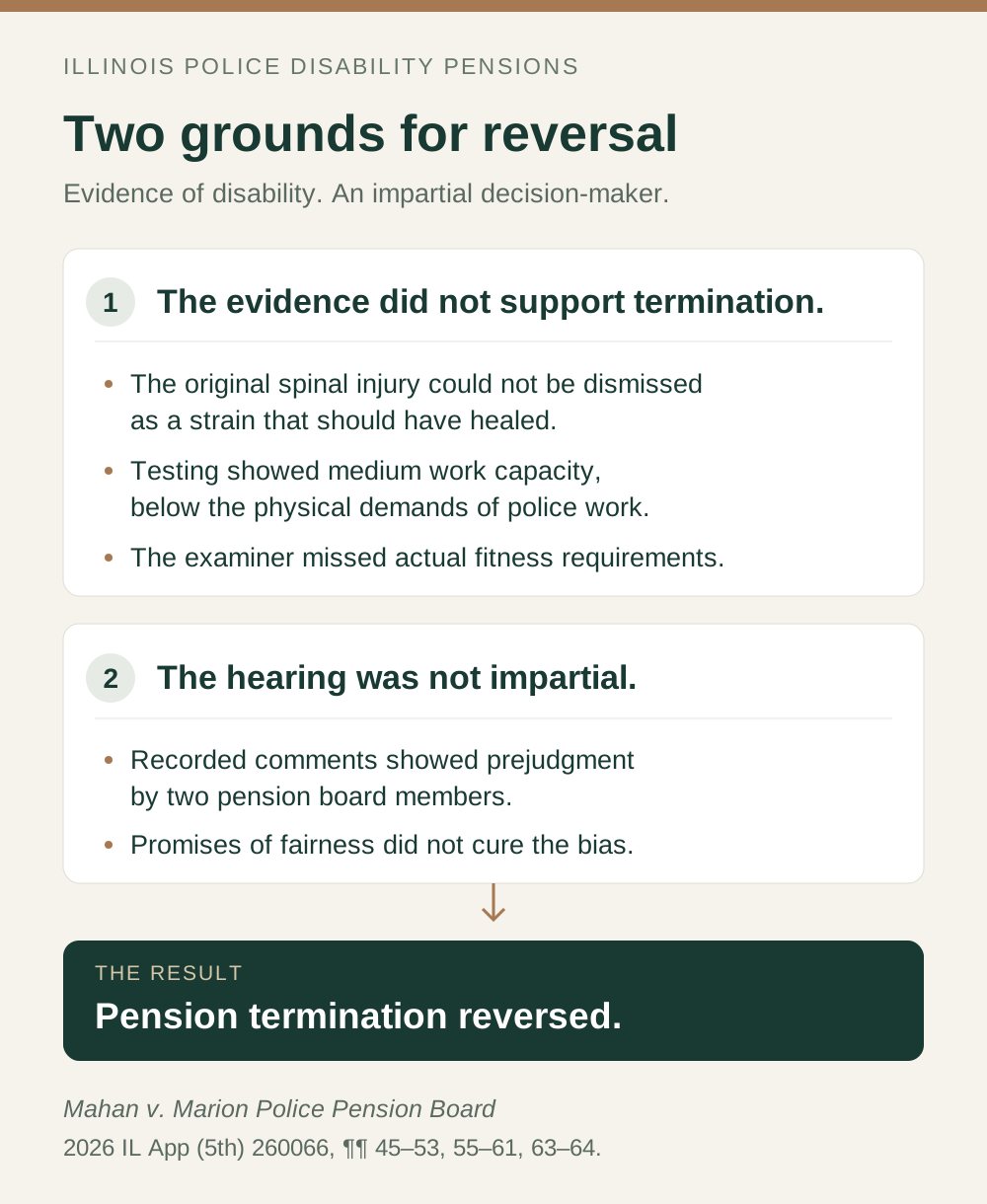
The Board relied on orthopedic surgeon Dr. Chintan Sampat, who concluded that Mahan could return to unrestricted police duties. The appellate court found two central problems with that conclusion. Opinion, ¶¶ 44–48.
The opinion treated the original injury as a temporary strain
The physicians who supported the original disability finding had identified a disc herniation and an osteophyte affecting a nerve root. They considered surgery too risky and found permanent disability. Dr. Sampat instead described the original injury as a strain that would have resolved within weeks. The court questioned how that analysis established recovery from the condition on which the pension award actually rested. Opinion, ¶¶ 45–46.
The opinion did not resolve the functional evidence
A functional capacity evaluation, or FCE, measures what a person can physically do through a series of tasks. Both the 2018 and 2024 evaluations placed Mahan in the medium physical-demand category, below the heavy demands identified for police work. The earlier evaluation reflected full effort. Dr. Sampat testified that he had not been provided the 2018 FCE. Opinion, ¶¶ 34, 36. Opinion, ¶¶ 52–53.
The Board and the physician questioned the reliability of the later evaluation. But the court explained that those concerns did not account for the earlier test, which also showed limited capacity despite full effort. The point was not that an FCE always defeats a physician’s opinion. The point was that this physician’s opinion did not adequately address material evidence of continuing limitations. Opinion, ¶ 53.
Why did the physical demands of police work matter?
Reading a general job description did not answer whether Mahan could satisfy the job’s actual physical requirements. The Marion job description referred to physical-ability standards established locally and by Illinois. Dr. Sampat acknowledged that he did not know the exact requirements and had not requested additional documentation explaining them. Opinion, ¶ 34. Opinion, ¶¶ 47–48.
The court examined Illinois’s POWER fitness tests, including flexibility, sit-ups, bench press, and a timed 1.5-mile run. It connected those requirements to the demands of police work and the testing in Mahan’s record. His functional evaluations did not establish the capacity needed for those demands. Opinion, ¶¶ 49–53.
This part of the opinion should be read carefully. The court used the standards to evaluate the evidence before it and questioned why the same requirements would not apply to an officer returning after an injury. The decision should not be reduced to a universal rule that every officer returning from any absence must retake every POWER test. Its immediate lesson is that a recovery opinion must engage with the relevant physical demands, rather than assume them away.
How did the pension board members’ comments violate due process?
A pension hearing requires an impartial tribunal. Administrative decision-makers are presumed to act fairly, and familiarity with a case or a mere possibility of bias is insufficient. But a claimant can establish disqualifying bias when a disinterested observer could conclude that a decision-maker had prejudged the facts and law before hearing the case. Opinion, ¶¶ 54–55.
Mahan offered a recording of a March 2023 Board meeting concerning retroactive benefits after the prior reversal. The discussion included remarks about him arriving by jogging, teaching Zumba, and the Board winning the next hearing. A member approved the retroactive payment under protest. Mahan sought to exclude Henry and Beasley Wright from the later review panel. Opinion, ¶¶ 4–8.
The Board argued that the comments were jokes taken out of context. Both members assured the hearing officer that they could decide the case fairly. The appellate court found that the context made the comments more troubling: they concerned the officer’s physical capacity, the very question to be decided at the next hearing, and reflected opposition to paying benefits and a desire to win before new evidence had been developed. Opinion, ¶¶ 56–61.
The court held that allowing the two members to remain on the panel denied Mahan due process. It suggested their removal from the panel for future hearings involving him. It did not order their permanent removal from the pension board. Opinion, ¶¶ 61–64.
What should Illinois officers and pension boards take from the case?
For an injured officer facing a pension review, Mahan highlights the importance of a record that connects medical limitations to real police work. For pension boards, it underscores the need to test a recovery opinion’s reasoning and preserve an open mind. The following are practical lessons from the decision:
- Start with the condition that supported the award. Compare the original medical findings with the current evidence of recovery.
- Identify the actual job demands. General descriptions may need supporting physical standards and an explanation of tasks such as pursuit, restraint, lifting, and assisting other officers.
- Read the functional record across time. An earlier evaluation showing full effort and persistent limitations may matter when a later examiner questions reliability.
- Preserve evidence of prejudgment. The meeting recording and the motion to exclude the members gave the reviewing court a concrete record to assess.
- Keep adjudication separate from a desire to win. The Board’s task is to decide eligibility fairly. A later promise of impartiality may not overcome documented prejudgment.
These are lessons about proof and process, not a prediction of the result in another officer’s case. Opinion, ¶¶ 45–53. Opinion, ¶¶ 55–61.
What did the ruling leave unresolved?
- No unconditional lifetime entitlement. The opinion recognizes that continued benefits depend on continued disability.
- No automatic hierarchy of medical evidence. It identifies deficiencies in this record; it does not declare that every FCE outweighs every independent medical examination.
- No rule that every ill-considered comment requires disqualification. The court assessed the statements in context under the standard for prejudgment.
- No damages or attorney-fee award in this opinion. Its stated disposition is reversal of the termination, not a new monetary award or a specified remand hearing.
The decision is now a published opinion, rather than merely the earlier Rule 23 order. The official PDF records the September 2 order and October 6 publication grant; the Illinois Courts index listed the opinion as Slip on October 6, 2026. A slip opinion remains subject to possible modification. Read the published opinion.
Frequently asked questions
What did the court decide in Mahan v. Marion Police Pension Board?
The Illinois Appellate Court reversed the termination of Joshua Mahan’s line-of-duty disability pension. It held that the Board’s recovery finding was against the manifest weight of the evidence and that two board members’ prejudgment denied him due process.
Can an Illinois police disability pension be terminated after it is awarded?
Yes. As Mahan explains, continued entitlement depends on continued disability, and benefits may be terminated upon recovery. The court held that the record in this case did not support the Board’s finding that Mahan had recovered sufficiently to perform police duties.
Does working a civilian desk job prove that an officer can return to police work?
It did not establish recovery in Mahan. He sold modular homes in a largely desk-based role, while the disputed police duties involved greater physical demands. The court examined his capacity to perform police work, including the applicable physical requirements. Outside employment must be evaluated under the governing law and facts.
Does a functional capacity evaluation always outweigh an independent medical examination?
No. Mahan does not establish an automatic preference. The court identified specific flaws in the medical opinion the Board relied on, including its treatment of the original injury and its failure to address actual physical requirements and earlier testing showing limited capacity despite full effort.
When can pension board comments violate an officer’s right to a fair hearing?
In Mahan, recorded comments about the officer’s physical abilities and winning a future hearing showed prejudgment when considered in context. The court required more than a mere possibility of bias. Later assurances of impartiality did not overcome the evidence, and the two members’ participation denied due process.
Did the court order the two trustees removed from the pension board?
No. The court found that their participation violated due process and suggested their removal from the panel for future hearings involving Mahan. It did not order their permanent removal from the pension board or bar all future reviews of his eligibility.
Is Mahan a published Illinois appellate opinion?
Yes. The order was filed September 2, 2026, and the motion to publish was granted October 6, 2026. The published citation is 2026 IL App (5th) 260066, without the -U suffix of the earlier order. Illinois Courts listed the opinion with Slip status on October 6, 2026.
Primary sources and editorial note
- Mahan v. Marion Police Pension Board, 2026 IL App (5th) 260066 (official published opinion, PDF). All paragraph references above are to this version.
- Illinois Courts opinion index and explanation of opinion status.
Analysis prepared October 6, 2026, from the published opinion. The conceptual illustration and explanatory graphic do not depict the parties, an actual meeting, or medical findings. This article provides general legal information, not advice about a particular claim. See the site disclaimer.