A work vehicle rear-ends a semitruck. The employee in the passenger seat says his seatbelt failed. The employer has investigated the driver’s speeding, but the vehicle’s GPS records are not produced at trial. What evidence can the employee use to prove his case?
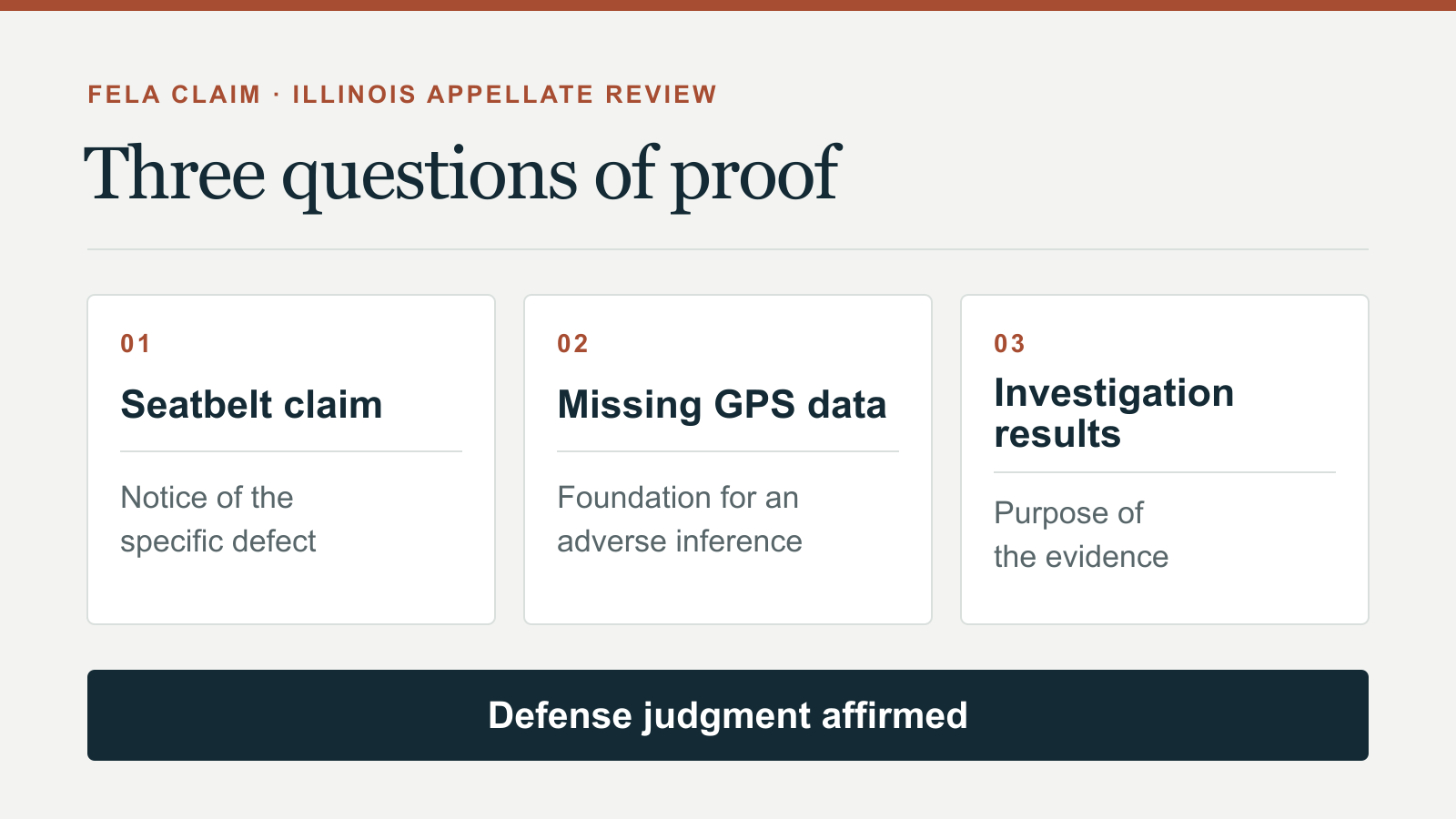
Napoles addresses those questions under the Federal Employers’ Liability Act, commonly called FELA. The decision illustrates how a claim can turn on proof of a particular unsafe condition, the foundation for a jury instruction, and the purpose for which evidence is offered.
- Case
- Napoles v. Northeast Illinois Regional Commuter R.R. Corp., 2026 IL App (1st) 251212
- Court
- Illinois Appellate Court, First District, Sixth Division
- Filed
- October 30, 2026
- Claim
- Railroad employee’s FELA negligence action arising from a work-related pickup-truck collision
- Result
- Judgment for Metra affirmed
What happened in Napoles v. Metra?
Daniel Napoles worked for Metra as an assistant signalperson. On November 21, 2016, he was riding in a Metra pickup truck driven by coworker Mike Collopy to a job site. On Interstate 90 near the Route 25 exit, the pickup collided with the rear of a semitruck that had merged into its lane. The semitruck did not stop. Opinion, ¶¶ 3–4.
Napoles alleged that the collision threw him into the dashboard, windshield, and passenger door, causing serious injuries. He said he had fastened his seatbelt and heard it click, but the belt failed to restrain him and the airbag did not deploy. Those were allegations of equipment failure; the court did not treat them as established defects. Opinion, ¶¶ 5–9.
The truck’s condition raised other concerns. The record included a rusted floorboard through which the road was visible, doors that had to be locked to stay closed, and numerous maintenance issues. The trial court allowed the remaining unsafe-workplace claims to proceed, while granting partial summary judgment on the allegation that Metra failed to provide functional seatbelts and airbags. Opinion, ¶¶ 8–13.
At trial, the witnesses disagreed about how the crash unfolded. Collopy described a semitruck abruptly entering his lane and braking. Napoles described the pickup traveling above 70 miles per hour, closing the distance, and a driver who appeared inattentive. A statement he allegedly made to a doctor on the day of the crash described a sudden merge and a collision below 60 miles per hour. The jury returned a unanimous verdict for Metra. Opinion, ¶¶ 16–26.
FELA’s favorable causation standard still requires proof of negligence
FELA provides a federal negligence remedy for railroad employees injured on the job. The appellate court recognized the railroad’s duty to provide a reasonably safe workplace and the statute’s favorable causation standard: employer negligence need only play some part, even a slight one, in producing the injury. But a plaintiff still must offer evidence supporting negligence, including breach, foreseeability, and causation. Opinion, ¶¶ 31–33.
For the seatbelt theory, the appellate court focused on whether Metra had actual or constructive notice of the alleged unsafe condition. Actual notice concerns what the employer knew. Constructive notice concerns a condition the employer should have discovered under the circumstances. Opinion, ¶¶ 37–39.
The evidence showed routine inspections reporting the seatbelt in satisfactory condition. Napoles acknowledged that it clicked into place before the crash, and the record contained no prior complaints or reports of seatbelt problems. The court found insufficient evidence that Metra knew or should have known of the alleged defect. Opinion, ¶¶ 40–41.
The truck’s broader deterioration did not fill that gap. A problem with one vehicle component does not, by itself, establish a defect in another. Evidence of rust and other maintenance problems supported allowing other theories to reach trial, but did not establish the necessary inference about the seatbelt. Opinion, ¶¶ 35–36.
The practical lesson is to connect the proof to the specific condition alleged to have caused the injury. Prior complaints, inspection records, the duration and detectability of a defect, and appropriate technical evidence may matter. The decision does not make prior complaints the only way to establish notice, or hold that a seatbelt that clicks must be safe.
Missing GPS records did not automatically entitle the employee to an adverse inference
Metra’s pickup had GPS equipment that tracked location and speed. A Metra investigator testified that he reviewed the data after the crash and that copies were filed and provided to a hearing officer. The records themselves were not produced at trial. Napoles requested Illinois Pattern Jury Instruction 5.01, which can allow jurors to infer that missing evidence would have been unfavorable to the party that failed to produce it. Opinion, ¶¶ 21, 25, 43.
The court explained that the instruction requires a foundation for each of four points:
- The other party controlled the evidence and could have produced it with reasonable diligence.
- The evidence was not equally available to the party requesting the instruction.
- A reasonably prudent person would have offered the evidence if it were favorable.
- No reasonable excuse explained the failure to produce it.
The instruction is also unwarranted when the missing evidence would merely repeat facts already established. The trial court’s decision is reviewed for abuse of discretion. Opinion, ¶¶ 44–45.
Here, the record did not conclusively establish what happened to the GPS data after it went to the hearing officer. The trial judge noted that counsel had not followed up with a question about its ultimate disposition. Metra later offered an explanation: Collopy admitted the internal speeding charges, so no disciplinary hearing occurred, and the hearing officer’s file likely underwent routine destruction. The appellate court accepted that as a reasonable excuse on this record. Opinion, ¶ 25. Opinion, ¶ 46.
There was a separate reason the appeal failed: the court found no prejudice. The jury had already heard testimony that Metra determined Collopy was speeding. The appellate court considered the GPS evidence cumulative of that testimony and concluded that refusing the instruction did not warrant reversal. Opinion, ¶¶ 47–49.
That conclusion has limits. The opinion does not establish when or whether the data was actually destroyed. It does not decide a separate spoliation claim or analyze a duty to preserve evidence for litigation. Its treatment of Metra’s explanation should be read in the context of this requested instruction and this trial record.
Why couldn’t the employee rely on Metra’s disciplinary findings?
Napoles also sought to introduce investigation results showing that Collopy faced discipline for violating Metra’s safety rule requiring compliance with traffic laws, posted speed limits, and reasonable driving speeds. The trial court excluded that evidence. Opinion, ¶¶ 51–52, 57.
The appellate court upheld the ruling on several grounds. First, the investigation results could mislead the jury about the legal standard of negligence. Second, Metra’s investigation, charging decision, and scheduling of a disciplinary hearing fell within postaccident remedial actions when offered to prove Collopy’s negligence. The rule excluding subsequent remedial measures serves, among other purposes, to encourage safety improvements. Opinion, ¶¶ 54–57.
The court recognized that remedial-measure evidence may be admissible for other purposes, including disputed ownership or control, disputed feasibility of precautions, or impeachment without an inference of prior negligence. Napoles had not advanced those exceptions. The court again found that the excluded evidence was cumulative of speeding testimony the jury had already heard. Opinion, ¶¶ 56–59.
The ruling concerns the investigation and disciplinary results offered for this purpose. It does not create a blanket privilege over accident investigations or declare that underlying GPS records are automatically inadmissible. Lawyers must identify the particular evidence sought, the purpose it serves, and how it adds to the trial record.
What should injured workers and their attorneys take from the decision?
The recurring issue in Napoles is the connection between an allegation and the evidence needed to establish it. Several practical lessons follow from the court’s reasoning:
- Develop each liability theory separately. General disrepair may support one claim while leaving a particular equipment-defect theory unsupported.
- Trace electronic records early. Identify who collected the data, where copies went, what retention practices applied, and what ultimately happened to the records. A missing-evidence request needs an evidentiary foundation.
- Explain what the missing evidence would add. If electronic records would establish precise speeds or a sequence of events beyond a general admission of speeding, develop that distinction in the record. The appellate court found the proposed evidence cumulative here.
- Separate accident facts from later discipline. Evidence of how a crash occurred and evidence of an employer’s response may present different admissibility questions.
- Address prejudice on appeal. An evidentiary challenge must explain how the ruling affected the case. The court repeatedly relied on the presence of other speeding testimony.
These are litigation lessons drawn from the opinion, rather than additional holdings. FELA’s favorable causation rule remains meaningful, but it works alongside the requirements for proving negligence and presenting admissible evidence.
For a broader discussion of collision records and investigation, see the Illinois truck accident guide. Railroad employees’ FELA claims follow a different legal framework from ordinary motor vehicle claims.
Frequently asked questions
What did the court decide in Napoles v. Metra?
The Illinois Appellate Court affirmed the judgment for Metra. It upheld partial summary judgment on the seatbelt theory, refusal of a missing-evidence instruction concerning GPS data, and exclusion of the investigation and disciplinary results offered to prove negligence.
Does a missing GPS record automatically justify an adverse inference?
No. The court required a foundation for the missing-evidence instruction, including control, availability, an expectation that favorable evidence would have been offered, and the absence of a reasonable excuse. It also found the proposed GPS evidence cumulative of testimony already before the jury.
Did the court rule that all accident investigations are inadmissible?
No. The decision upheld exclusion of the investigation and disciplinary results offered to establish the driver’s negligence. It recognized exceptions for certain other purposes and did not create a blanket privilege over accident records.
Does FELA guarantee recovery whenever a railroad employee is injured?
No. FELA provides a favorable causation standard, but the employee must still present evidence supporting negligence. In this case, the seatbelt theory lacked sufficient evidence that Metra knew or should have known of the alleged unsafe condition.
Primary source
Napoles v. Northeast Illinois Regional Commuter R.R. Corp., 2026 IL App (1st) 251212 (official opinion, PDF). All paragraph references are to this opinion, filed October 30, 2026. The opinion identifies the plaintiff as Napoles, although the download filename spells the name “Naples.”
Analysis prepared November 4, 2026. This article provides general legal information. See the site disclaimer.